For communities trapped in a cycle of catastrophe, a shelter is useless if it’s only a fortress; it must be a landmark that people recognise and trust. In the rural outskirts of Kuakata, a coastal town in southern Bangladesh, life is governed by seasonal extremes. Cyclones and monsoon floods arrive with regular intensity, making this one of the most exposed and vulnerable regions in the country. The terrain in Kuakata is shaped by the scars of these environmental hazards—eroded walkways suspended above the floodplain, gnarled remains of mangroves along the shoreline twisted by violent tides, and makeshift houses with tarpaulin walls dotted across the massive levee that spans the coastal perimeter. For the people here—mainly fishermen and subsistence farmers—survival depends heavily on land and sea, which are growing increasingly volatile with climate change. Most of them cannot afford to build structurally resilient homes, leaving them dependent on nearby storm shelters, schools, or government buildings. But in this unpredictable landscape, some local groups are slowly redefining what a shelter can be.
We tend to think of disaster shelters in terms of function: strong, simple, and utilitarian. Distinctiveness and identity are often treated as luxuries in the face of survival. But in practice, refuge depends on more than structural safety. A building that people do not recognise or feel connected to is a building they may not turn to in time when disaster strikes. In this sense, safety is inseparable from familiarity. Standing out in the surrounding landscape is part of what actually makes a shelter work.
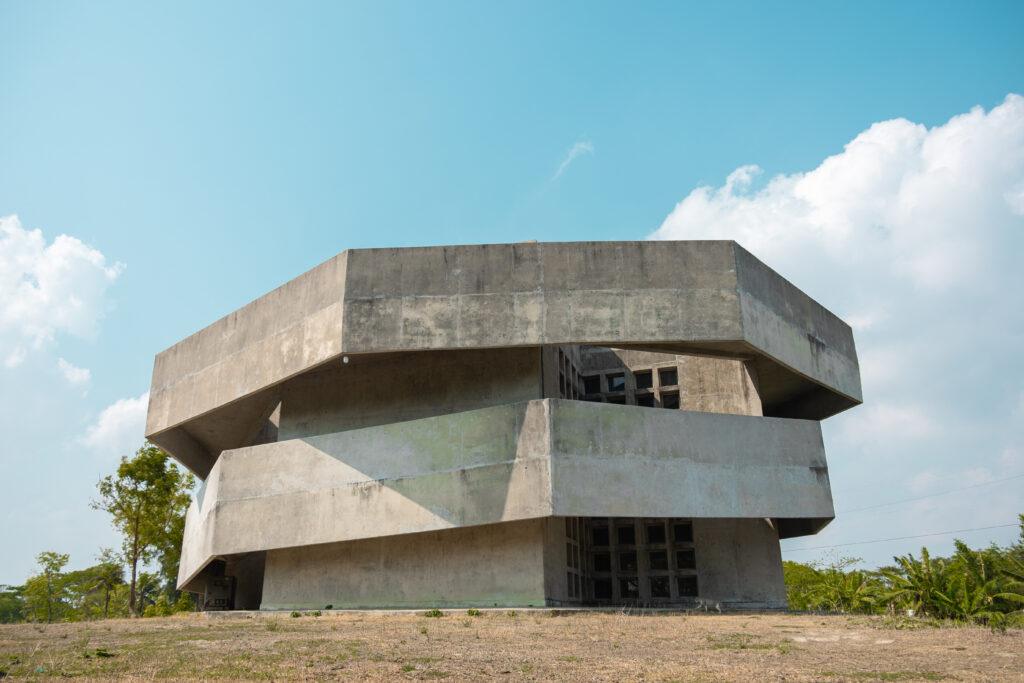
The Friendship cyclone shelter in Kuakata stands apart in the landscape as a visible point of refuge. Photo: Carly Althoff
On a raised mound overlooking the farmlands of Kuakata stands a cyclone shelter established by the Bangladeshi NGO Friendship. This strong, rectangular mass wrapped in a spiralized, geometric ribbon of concrete is markedly distinct from other nearby shelters. Its pronounced, angular shape can be identified from hundreds of metres away across the vast fields of rice and sunflowers that surround it. Since its construction in 2018, it has sheltered thousands of people, goods, and even cattle during storms. For those living in fragile wooden houses, access to this place can mean the difference between life and death. As the local gatekeeper explains, “Those who have good homes don’t come. Those who don’t have good homes disappear.”
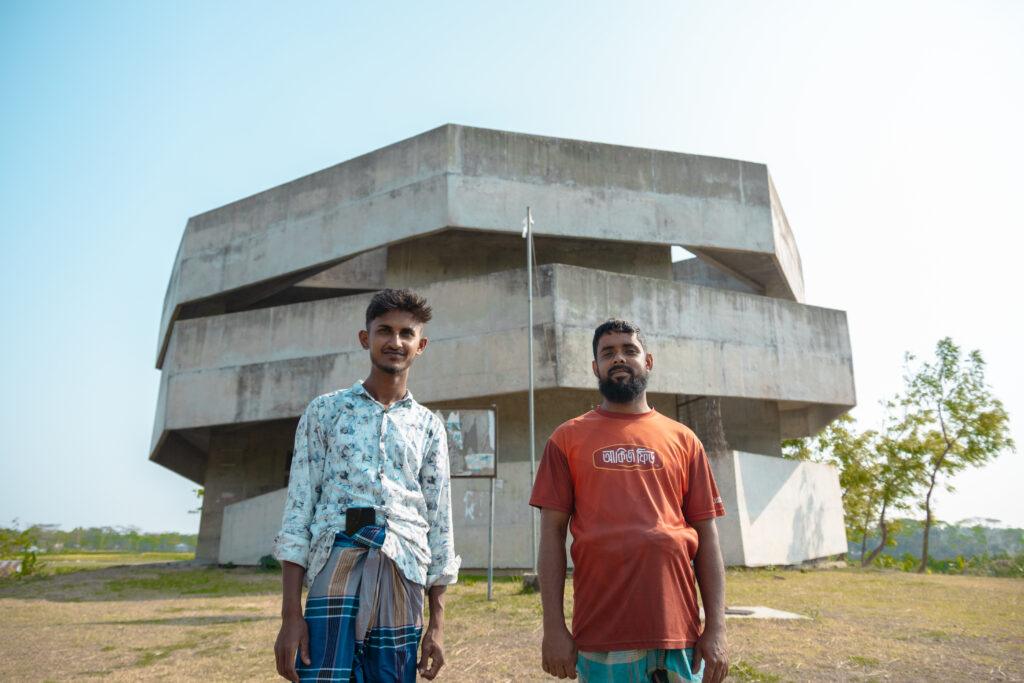
Known locally by name, the shelter functions not only as infrastructure but as a landmark. Photo: Carly Althoff
“Those who have good homes don’t come. Those who don’t have good homes disappear.”
There’s more to this cyclone shelter than its urgency. The man who holds its keys speaks of it not just as infrastructure, but as something to nurture. He takes care of it, shows it to visitors, and regards it with a sense of pride. People in surrounding villages know it by name, and they know where it stands on the hill. Its only wayfinding device is a faded metal poster standing on the roadside in front of the structure. But this building needs no signage—it is a beacon in and of itself. In moments of chaos, there is no hesitation about where to go because the place is known. This kind of recognition is so important because it shapes the behaviour of the users. A place that is visible, distinct, and embedded in the local discourse becomes part of the social fabric, making it easier to trust and easier to reach.
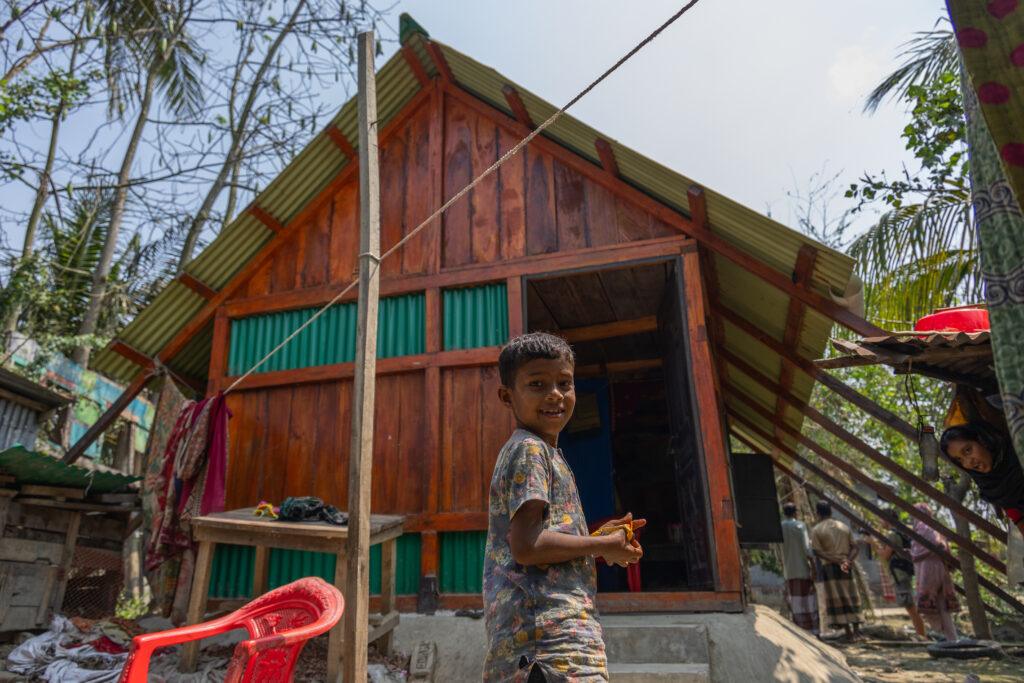
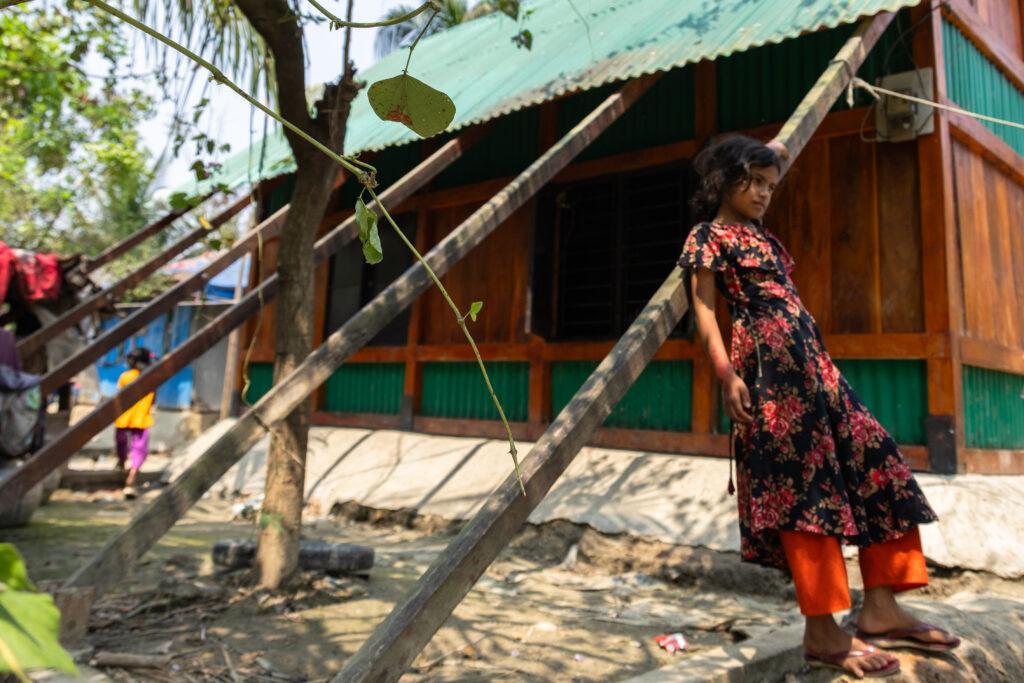
The raised A-frame house was designed to withstand floods and storms while remaining familiar to daily life. Photo: Carly Althoff
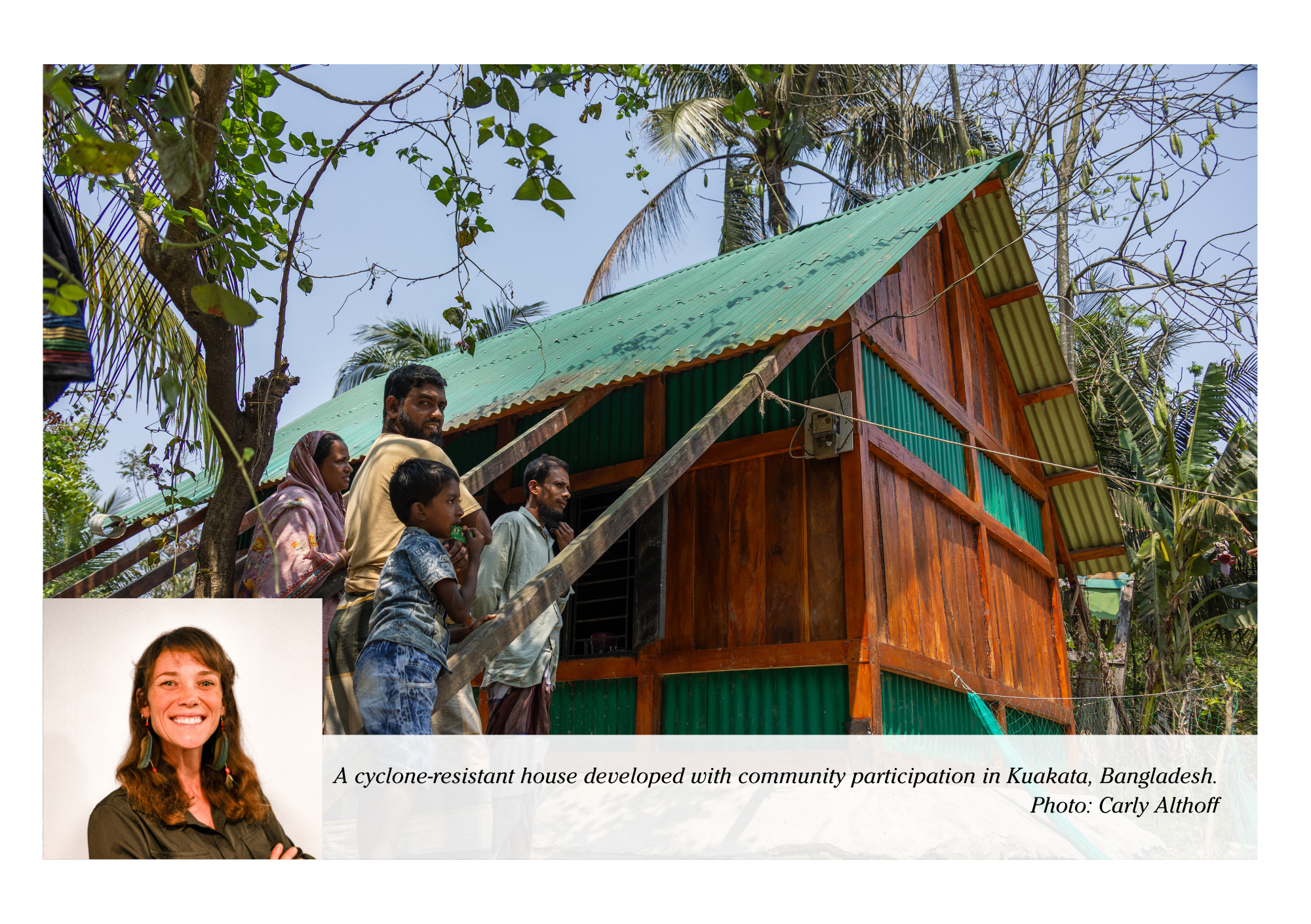
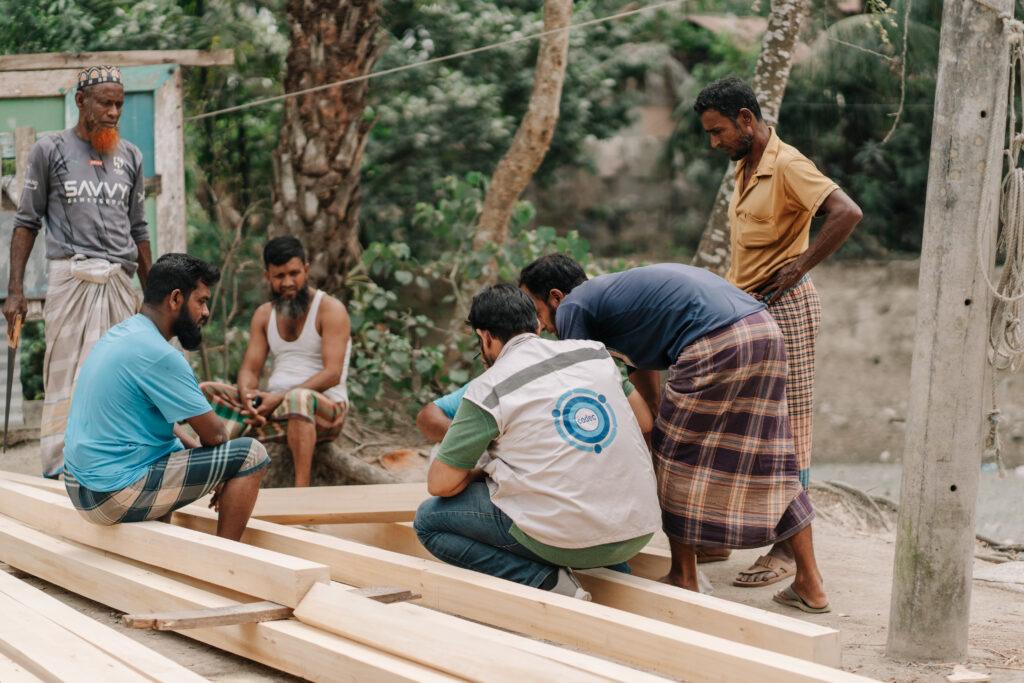
A similar principle is demonstrated by the organisation CODEC, which has developed a concept of cyclone-resistant homes for rural families. Tucked away in the centre of one of the most economically vulnerable communities, this house sits as a prized centrepiece. It has an A-frame form which helps reduce wind resistance and increases structural stability, while an elevated base minimizes flood risk. While being of similar size and stature to the typical local home, the form of the building is certainly more striking. The project was developed with close attention to local context and acceptance. Rather than imposing a slightly unfamiliar design with no explanation, their project began instead with participation. Architect Hossenur Rahman Juwel describes a process of workshops, conversations, and collaboration. “Local craftsmen were involved in the construction process, which helped ensure that the design remained practical, appropriate, and easy to replicate using familiar techniques.” When a new design was introduced to the community, they wanted to assure a level of comfort amongst the people—if the building was too alien, they ran the risk of it being neglected. It needed to be innovative while also blending in with its environment.
“Local craftsmen were involved in the construction process, which helped ensure that the design remained practical, appropriate, and easy to replicate using familiar techniques.”
Community discussion during the design process helped shape a house that residents could recognise and accept. Photo: CODEC
The results reflect this balance of uniqueness and contextuality. Residents report not only increased safety during extreme weather, but also a sense of ownership. “The model has also generated interest in nearby communities, with some families expressing willingness to adopt or adapt the design for their own use,” Architect Juwel remarked. Not only has this A-frame home succeeded in safely withstanding storms, but it has also drawn interest in the village for its distinctive design. The family that resides here is eager to show it off—their disposition similar to the gatekeeper of the nearby cyclone shelter. Children play and hang from the wooden frame while women hang colourful laundry lines like decorative ornaments from the roof beams. A once-unfamiliar object has become integrated into the family’s rhythms.
Distinctive enough to be noticed, the house still sits close to the rhythms of its surrounding community. Photo: Carly Althoff
There is an underrated element of identity in the design of resilient homes and emergency facilities. When people take pride in the spaces meant to protect them, those spaces become part of daily life rather than distant infrastructure. They are maintained, respected, and relied upon, which in turn reinforces public safety. As the global climate continues to change, the challenge is not only to build stronger shelters, but to build places people will actually turn to when it matters.
Carly Althoff is an American architect and documentary storyteller whose work explores how communities respond to environmental and social change. Over the past decade, she has worked with nonprofit organisations across Africa, Asia and Latin America to support and document meaningful, locally led design projects. Through her interest in culture, place and everyday resilience, she seeks to amplify grassroots forms of social and environmental change that deserve greater visibility and support.