- Interview
What Changes When an Architect Designs at the Scale of the Hand?
- Candice Lim
Architect Alexis Dornier works across buildings, spatial installations and objects. In this conversation, he reflects on what changes when design moves between those scales; and what precision, fabrication and the knowledge of makers can teach an architect about where to exert control, and where to relinquish it.
I first came across Alexis Dornier’s work some years ago, when I was managing publications on sustainable architecture and design. I remember being drawn to the apparent ease of his architecture in Bali, and particularly to the way material retained its own character rather than being made subservient to form.
More recently, I learnt of VIDAR, his collaboration with Ahti Interiors, which brought his thinking into the particularly intimate scale of bathroom fittings. What got me interested went beyond the collection itself: what happens when someone accustomed to designing buildings works at the scale of something held, touched and used; and whether that experience changes the way he subsequently thinks about architecture.
That became the starting point for this conversation.
Your practice now moves between architecture, spatial installations and objects. When the scale changes radically, from something inhabited to something held or touched, what remains constant in the way you begin designing?
AD: I tend to begin with a relationship rather than a form: how things meet, how they are held, how they touch the body, the ground, or one another. That remains remarkably constant across scales.
In architecture this may become a structural system, a sequence of spaces or the relationship between a building and its landscape. In an object it might be the way your fingers encounter a surface or the resistance of a control as you turn it. The scale changes, but I am still looking for a kind of tectonic clarity—an idea that can be understood through how something is made and experienced.
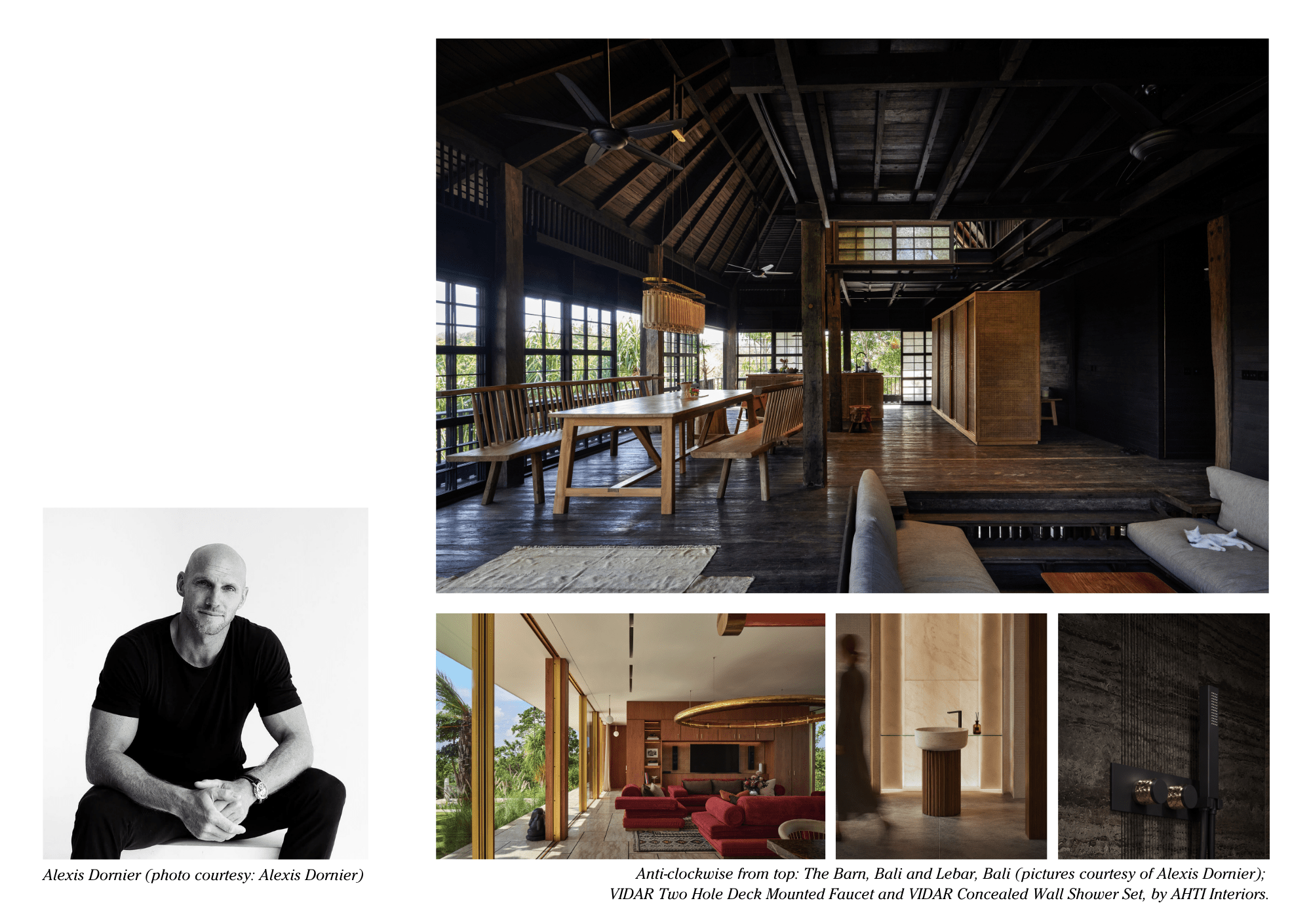
With VIDAR (collaboration collection with Ahti Interiors), for example, I wasn’t interested in making a miniature piece of architecture. I was interested in whether the same concerns I have in architecture—proportion, material, precision, tactility and ritual—could survive at the scale of the hand.
A building derives much of its logic from a particular site, programme and set of constraints, whereas an object may need to work repeatedly in different settings. How does your thinking change when context is no longer fixed in quite the same way?
AD: With architecture, I like constraints because they give you something to push against. The site is already speaking before you arrive.
An object doesn’t necessarily have that fixed geographical context, so I think the context shifts toward the body and toward ritual. A tap, for instance, may end up in Singapore, Bali or Berlin, but the relationship between hand, water and object remains surprisingly constant.
That universality is interesting to me. You have to remove some of the specificity that architecture allows while retaining enough character that the object doesn’t become anonymous. It becomes an exercise in reduction: determining what is essential and what is merely circumstantial.
At a smaller scale, questions of fabrication, tolerance and physical use can become very immediate. Does working closer to those constraints alter the design process, or expose things that are less apparent when you are working at the scale of a building?
AD: Absolutely. At product scale there is nowhere to hide. A millimetre matters. The radius of an edge matters. The gap between two components matters. The weight of something in your hand matters.
Architecture can sometimes absorb imperfection through distance. An object cannot. You experience it at 20 centimetres rather than 20 metres.
What I enjoy is that this forces a very direct feedback loop between drawing, prototype and physical experience. You draw something, make it, touch it, discover that it isn’t quite right, and change it. That process has made me more sensitive to tolerances and transitions in architecture as well. Increasingly I find myself interested not simply in what something looks like, but in exactly how one material stops and another begins.
There is often a considerable distance between an architectural drawing and the person who eventually makes a particular component. Has working more directly with makers and manufacturers changed your understanding of what can, or should, be resolved through drawing alone?
AD: Yes. I have become less interested in the idea that the drawing has to contain the entire intelligence of the object.
Living and working in Indonesia has reinforced this. There is extraordinary knowledge embedded in making—in timber, bamboo, stone, metal, weaving—that doesn’t necessarily originate on a computer screen. A drawing can establish intention, geometry and limits, but sometimes the person holding the tool understands something about the material that the drawing cannot.
The hand-hammered surfaces in VIDAR are a good example. We can define the geometry, proportion, density and character we are looking for, but if we completely prescribe every mark, we destroy precisely what makes that surface interesting.
So I increasingly see the drawing as a framework for making rather than an instruction to eliminate interpretation.
“It has made me simultaneously more precise and less controlling.”
When the technical knowledge of a craftsperson, fabricator or manufacturer materially changes an idea, where do you locate authorship? How do you decide what needs to remain intact and what should be allowed to evolve?
AD: I don’t think authorship requires controlling every decision.
My responsibility is to know what constitutes the DNA of the idea. Certain things are non-negotiable because if you change them, the project becomes something else. But around that core there should be room for intelligence to enter from other people.
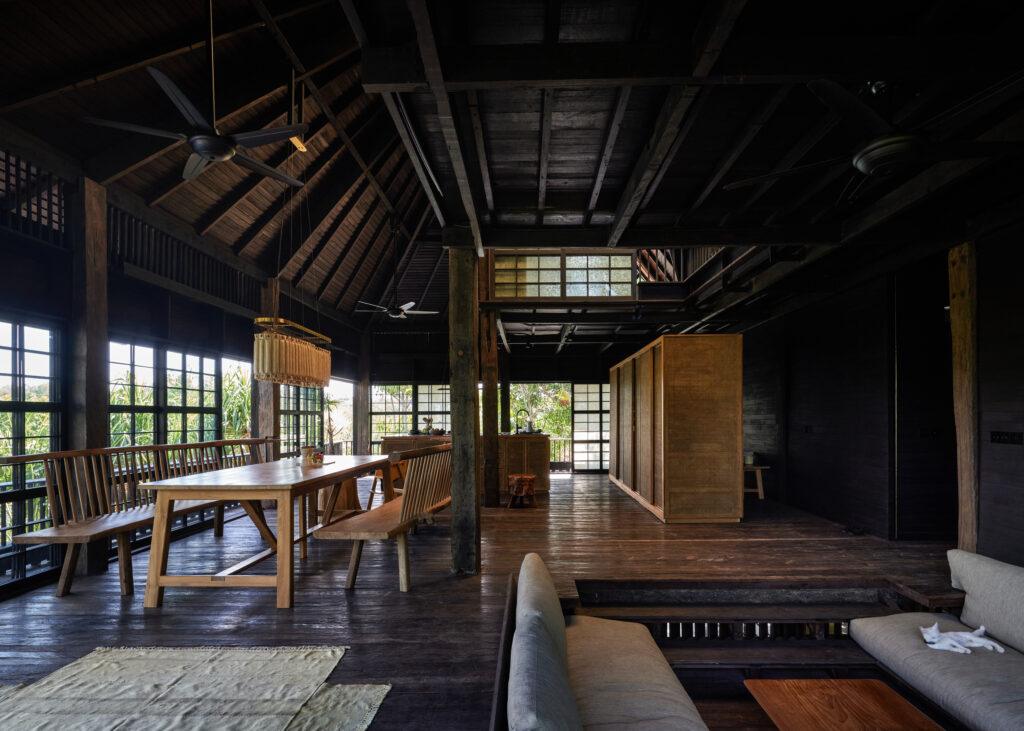
I have experienced this repeatedly in architecture. In The Barn, for example, we worked with reclaimed ironwood columns that were bent, twisted and completely non-standard. The point was not to machine away those irregularities until they obeyed the drawing. The architecture had to develop a system capable of accepting them.
I like that exchange. The architect establishes a framework, but material, craft and fabrication are allowed to push back. For me, authorship lies as much in curating and directing that process as it does in drawing the initial form.
Has working across these different scales changed anything about the way you return to architecture, whether in the way you think about detail, material, human interaction or how much an architect should actually design?
AD: It has made me simultaneously more precise and less controlling.
Product design has made me much more conscious of the last few millimetres—joints, edges, tolerances, tactility and the way the body actually encounters what we design. I bring much more of that attention back into architecture now.
But working closely with craftspeople has had almost the opposite effect. It has reminded me that not everything benefits from being predetermined.
Perhaps that is the larger lesson for me. The architect should design very precisely where precision gives the project its identity but also know where to stop. Good architecture isn’t necessarily the result of designing more. Sometimes it comes from establishing a strong system and then leaving enough space for material, landscape, craft, occupation and time to complete it.
Based in Bali, Alexis Dornier is an internationally recognised architect whose work spans residential, hospitality, and commercial projects around the world. Known for pushing the boundaries of contemporary architecture, his designs combine innovative structures with a deep respect for craftsmanship and place. Through thoughtful proportions, natural materials, and an intuitive understanding of light, Alexis creates spaces that are both bold and deeply human. His approach has earned international recognition and established him as one of the leading voices in contemporary tropical architecture.
- Continue Reading