Projects, policies and infrastructure moves I’m watching
Green development in Southeast Asia is becoming harder to read from project images alone. Some of the more consequential moves are now buried in energy procurement, district systems, data-centre rules, industrial-park infrastructure and city-level regulation.
Candice Lim
There was a time when green development was easier to recognise. A certified building. A planted deck. A shaded plaza. A project that could be described quite neatly from the outside.
Those examples still matter. They are just no longer enough.
Across Southeast Asia, some of the more important green development stories are now sitting behind the project image: how clean power is secured, how a district is operated, how a factory is supplied, how a city regulates buildings, how renewable energy finds physical space.
This watchlist is a short editorial scan. It is not a ranking. The point is to look at where sustainability is being pushed into delivery conditions—approvals, infrastructure, energy systems, operating rules and long-term performance.
Selected by The Future Atlas from publicly available project, policy and market information; not a ranking.
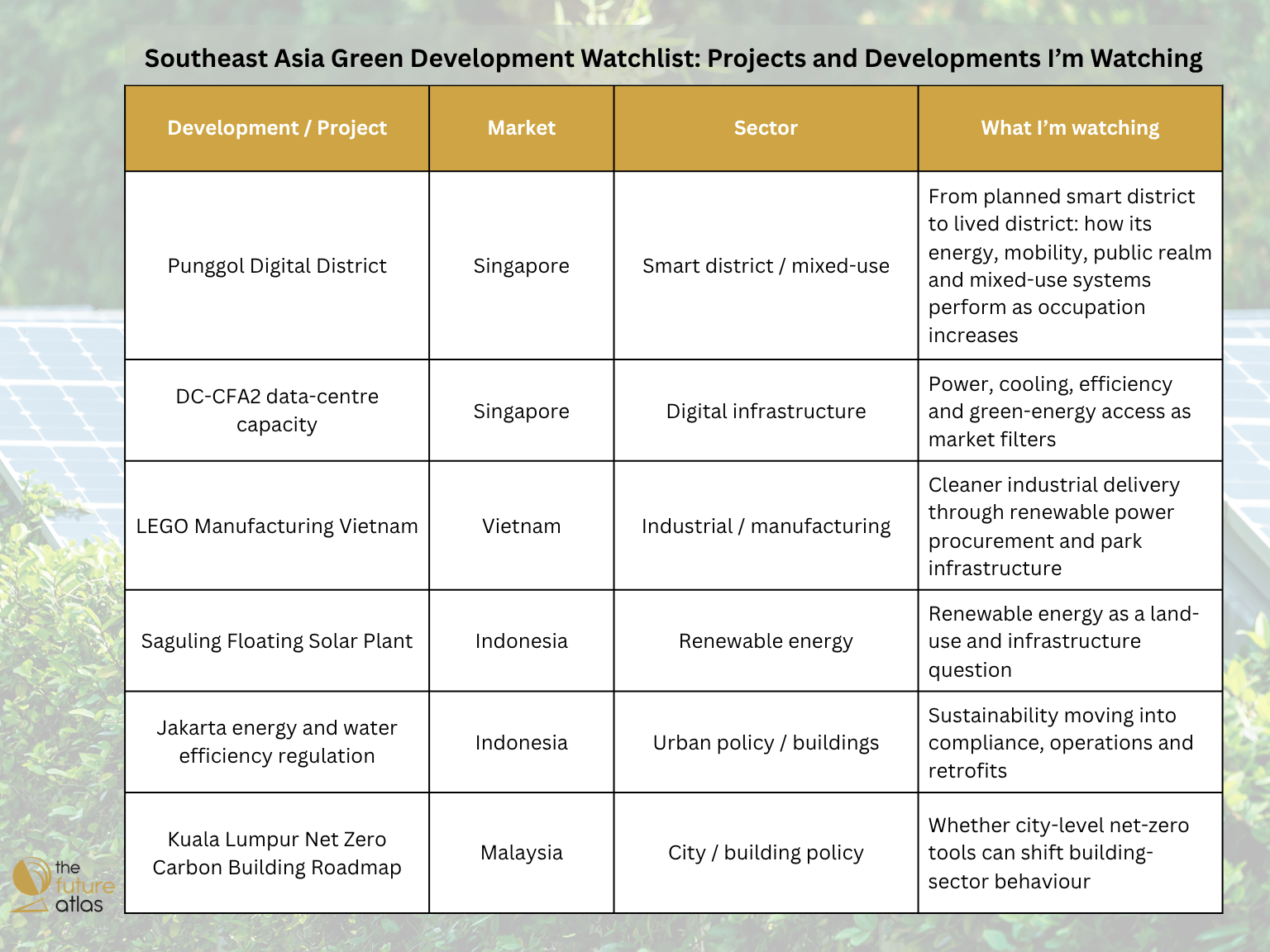
Punggol Digital District is useful because it is now entering the harder phase. Planning language is one thing; occupation is another. JTC has described PDD as Singapore’s largest mixed-use Green Mark Platinum District, with a targeted 35% yearly reduction in operational carbon emissions. The first phase, covering 21 hectares, was scheduled to open progressively from 3Q 2024. The district now has to be read through use: movement, energy, public realm, campus life, business activity and daily comfort. (JTC)
Singapore’s DC-CFA2 is not a project in the usual sense. That is why it belongs here. At least 200MW of new data-centre capacity is being made available, with the possibility of more through green-energy pathways. This makes capacity allocation part of the built environment story. Data centres are no longer only a real-estate or digital-infrastructure question; power, cooling and efficiency are becoming entry conditions. (Infocomm Media Development Authority)
LEGO Manufacturing Vietnam points to the industrial layer. The company says its direct power purchase agreement with VSIP covers integrated rooftop solar and battery energy storage, and forms part of its ambition to run the Vietnam factory on 100% renewable energy. The interesting part is the surrounding system: the factory, the industrial park, the energy centre, the procurement structure. (LEGO)
Saguling Floating Solar Plant brings the discussion back to land. PLN has started construction of the 92MWp floating solar plant on the Saguling Reservoir in West Java, with commercial operations targeted for November 2026. The plant is expected to generate more than 130GWh annually. For dense or contested land-use environments, floating solar asks a simple question with complicated answers: where can renewable energy be placed? (Reuters)
Jakarta and Kuala Lumpur sit more on the regulatory side. Jakarta has unveiled Governor Regulation No. 5 on energy and water efficiency in buildings, giving the city a legal framework for building-sector efficiency. Kuala Lumpur has launched its Net Zero Carbon Building Roadmap 2050, with a stated target of 70% reduction in carbon emissions intensity by 2030. These are not developments you photograph in the usual way. They matter because they change what future projects have to submit, measure, retrofit or prove. (C40 Cities)
The useful part is not the green label. It is the machinery behind it.
Power. Cooling. Documentation. District systems. Procurement. Regulation. Land. Occupation.
That is where Southeast Asia’s next phase of green development is beginning to show itself.
Sources
JTC, “Punggol Digital District clinches Platinum Award for BCA Green Mark Districts,” May 2024. (JTC)