Sustainability is now shaping how built environment firms are evaluated, shortlisted and awarded projects—but many still struggle to operationalise it. The real differentiator is not commitment, but the internal capability to deliver.
From commitment to capability
Across the built environment sector, sustainability is no longer a side conversation. It is shaping how firms are evaluated, how projects are awarded, how partnerships are formed, and how future-ready a business appears to clients, investors and stakeholders. But a public commitment alone is not enough.
What increasingly separates resilient firms from the rest is internal capability: the ability to turn sustainability from intent into action.
In the built environment, this means moving beyond declarations and reporting. Sustainability must be embedded into operations, systems, workforce readiness, documentation, leadership alignment and day-to-day decision-making. Without that, even well-intentioned firms risk falling behind as expectations continue to rise.
Turning sustainability into operations
One of the biggest gaps is that many companies understand sustainability conceptually but have not built the structures needed to operationalise it. Leadership may want to move in the right direction, but there is often no clear roadmap, no defined ownership, no documented processes and no capability-building plan. As a result, sustainability remains a management discussion rather than a business reality.
This is especially critical in the built environment, where firms operate within complex ecosystems involving multiple stakeholders, compliance requirements, procurement pressures and long project cycles. In this context, sustainability cannot remain a communications exercise. It must become part of business transformation.
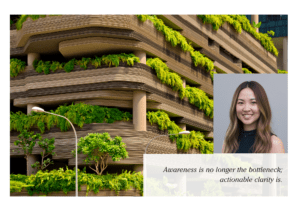
This is an excerpt of Serene Kwok’s article published in Future Atlas 1Q 2026 digital edition. Read the full story there.
Serene Kwok is the Chief Transformation Strategist at Bluehive Consulting, where she helps businesses navigate ESG-led and AI-enabled transformation across strategy, operations, workforce capability-building, and brand positioning. She is a Professional Singapore Certified Management Consultant (PSCMC), a Certified Sustainability Practitioner, and a Certified Generative AI Practitioner, with extensive experience supporting SMEs and growth-stage companies in building future-ready, resilient and competitive organisations.