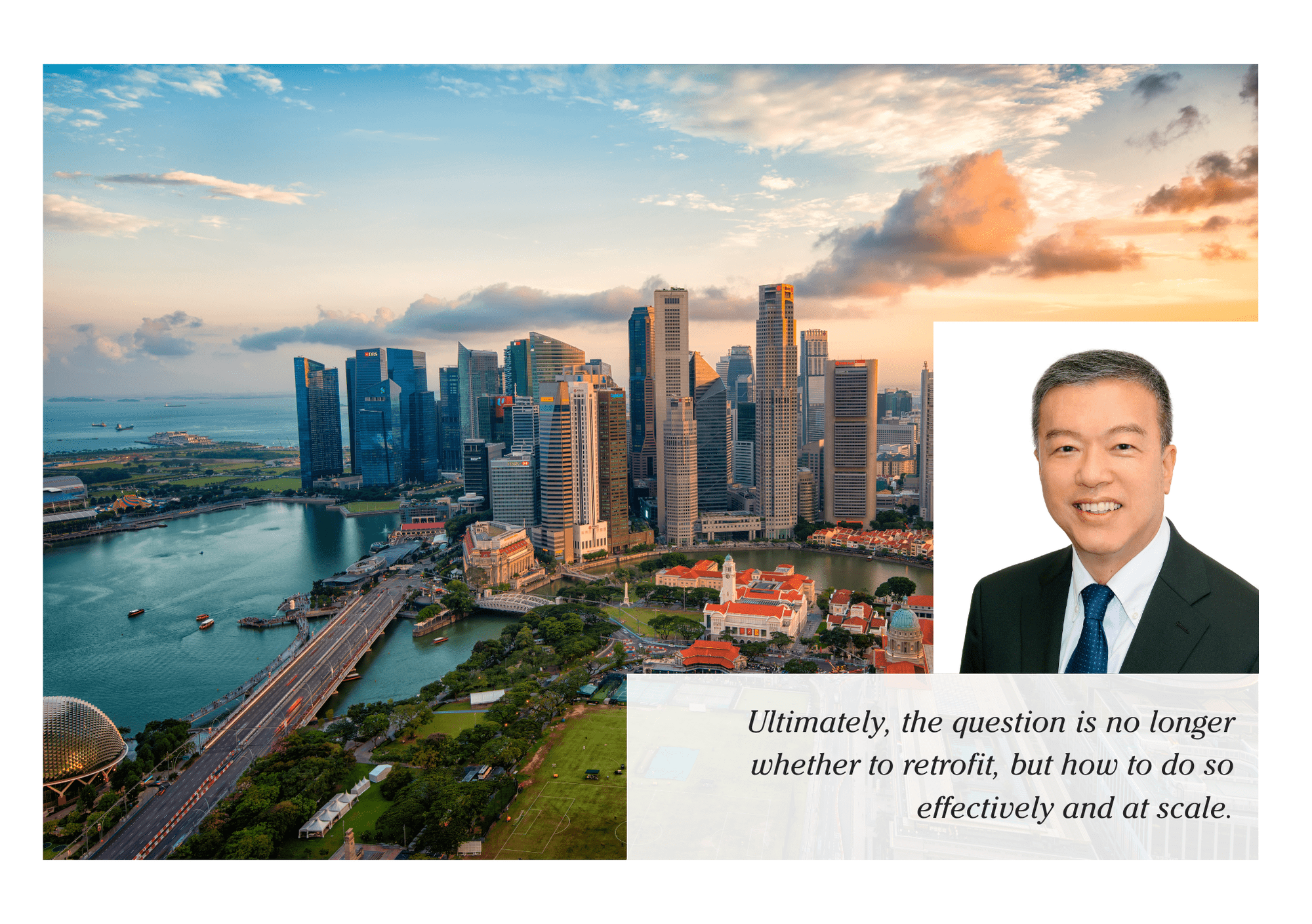
Allen Ang looks at what Singapore’s built environment decarbonisation agenda demands once it moves beyond targets and into the owner-developer realities of existing buildings, retrofit decisions, whole-life carbon and long-term asset performance.
For existing buildings, what still makes decarbonisation and retrofit decisions difficult in practice?
Decarbonising existing buildings remains one of the most important opportunities in Singapore’s net-zero journey, but it is also one of the most complex. Unlike new developments, where sustainability can be integrated from the outset, existing buildings must work within the realities of existing infrastructure, operational requirements and business continuity.
The challenge today is less about intent and more about implementation. While technologies and solutions have advanced significantly, building owners still need to evaluate factors such as technical compatibility, cost-effectiveness, operational disruption, tenant requirements and return on investment.
The recent Schneider Electric–Singapore Green Building Council “Awareness to Action” report highlighted that many organisations continue to view retrofits primarily through a capital expenditure lens, rather than as a long-term value creation strategy. This is further complicated by split incentives, where landlords often bear upgrade costs while tenants enjoy much of the energy savings.
At the same time, expertise, financing and access to technical resources are not distributed evenly across the market, particularly among smaller building owners. The encouraging news is that awareness is growing, financing options are expanding, and successful retrofit case studies are showing that sustainability and business performance can go hand in hand.
Ultimately, the question is no longer whether to retrofit, but how to do so effectively and at scale.
Has the market genuinely moved beyond energy efficiency into whole-life carbon thinking, or is that shift still at an early stage?
The market is undoubtedly moving in that direction, and I am encouraged by the shift in conversations I have with business leaders across the industry.
A few years ago, discussions around sustainability were often centred on compliance obligations and immediate cost implications. Today, the conversation is increasingly focused on resilience, competitiveness, risk management and long-term value creation. More organisations are asking not, “Why should we do this?” but “How do we do this well?”
That said, I would describe the industry as being in a transitional phase rather than having fully arrived at whole-life carbon thinking.
Energy efficiency remains the most mature and commercially attractive starting point because it delivers measurable carbon reductions while generating tangible cost savings. As a result, operational carbon continues to receive significant attention.
However, awareness of embodied carbon, circularity, sustainable procurement, supply chain emissions and lifecycle impacts is growing rapidly. Government initiatives, industry standards, improved carbon data and stronger market expectations are helping to accelerate this shift.
This is an excerpt of Allen Ang’s interview published in Future Atlas 2Q 2026 digital edition. Read the full story there.
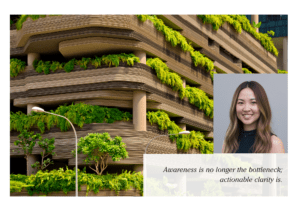
Allen Ang is President of the Singapore Green Building Council and Executive Vice President and Head of Green Building, Decarbonisation and Safety at City Developments Limited (CDL). A sustainability leader with over 20 years’ experience in green building and decarbonisation, he drives CDL’s net-zero transition, with work spanning City Square Mall, Singapore’s first eco-mall; the CDL Green Gallery, Singapore’s first zero-energy gallery building; and CDL’s large-scale adoption of Prefabricated Prefinished Volumetric Construction (PPVC). He helped position CDL as Southeast Asia’s first real estate conglomerate and Singapore’s first developer to sign the World Green Building Council’s Net Zero Carbon Buildings Commitment, aligned with 1.5°C targets. His work has contributed to CDL’s industry accolades, including the BCA Green Mark Platinum Champion Award and a Guinness World Record. He is also a recipient of multiple national awards.