Singapore–Batam Data Centres: A Cross-Border Digital Infrastructure Corridor
USRF™ Applications Series: March 2026
Singapore–Batam Data Centres:
A Cross-Border Digital Infrastructure Corridor in Southeast Asia
Using the Urban Systems Risk Framework (USRF™) to examine the emerging Singapore–Batam digital infrastructure system.
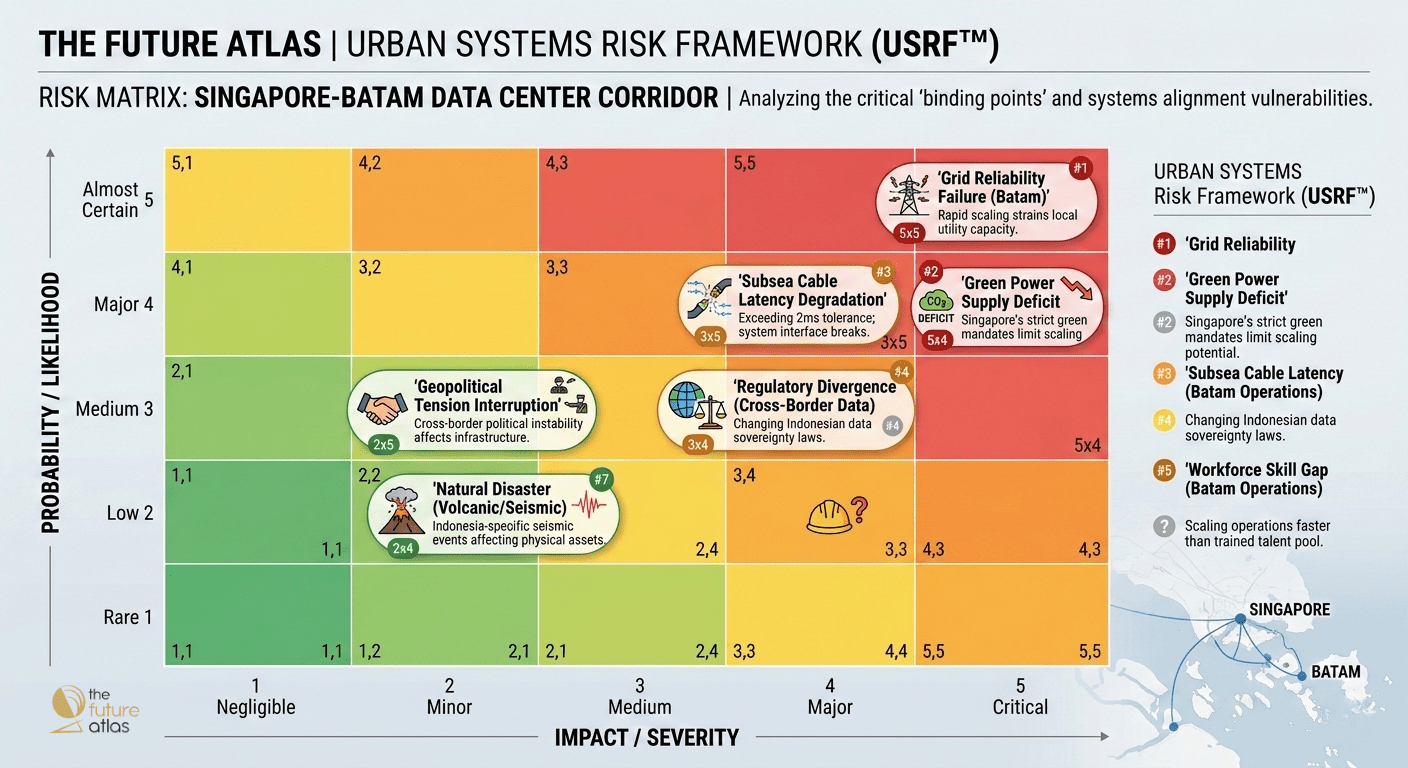
Figure: USRF™ Snapshot—System “Binding Points” in the Singapore–Batam Data Centre Corridor
Candice Lim
Across Southeast Asia, the expansion of data centres is increasingly shaped not just by demand for digital services, but by the alignment of multiple infrastructure systems—energy, connectivity, land availability, and regulatory frameworks.
One of the most interesting developments is unfolding just south of Singapore, where the Indonesian island of Batam is emerging as a complementary node to the region’s primary digital hub.
Viewed through The Future Atlas Urban Systems Risk Framework (USRF™), the Singapore–Batam corridor illustrates how hyperscale digital infrastructure is beginning to scale across regional systems rather than within single cities.
Singapore: Southeast Asia’s Digital Connectivity Core
Singapore remains one of the most connected digital infrastructure hubs in the world.
The city-state hosts a dense concentration of subsea cable landings, carrier exchanges, cloud regions, and enterprise connectivity infrastructure. This ecosystem density has made Singapore the primary gateway for digital traffic flowing between Southeast Asia and global networks.
However, Singapore’s structural constraints are increasingly visible.
Land availability is limited.
Power availability is tightly managed.
And the energy intensity of hyperscale data centres has become a central planning issue for policymakers.
A multi-year pause on new data centre development earlier in the decade reflected these pressures. While new capacity is gradually returning under stricter efficiency criteria, the constraints have pushed operators to consider how future infrastructure growth may extend beyond Singapore’s physical boundaries.
Batam: An Emerging Hyperscale Expansion Zone
Just 20 kilometres south of Singapore, Batam is positioning itself as a natural extension of the region’s digital infrastructure ecosystem.
Located within Indonesia’s Riau Islands Special Economic Zone, the island offers several structural advantages:
Larger land availability for hyperscale campuses
Lower land and development costs
Proximity to Singapore’s global connectivity ecosystem
Policy incentives designed to attract digital investment
Developments around Nongsa Digital Park are central to this strategy. The zone has been designed as a digitally focused economic cluster capable of hosting large-scale data centre infrastructure alongside supporting digital industries.
As demand for compute capacity continues to grow across Southeast Asia, Batam’s role as a potential expansion platform is attracting increasing attention from global operators and investors.
The Infrastructure Link: Subsea Connectivity
The emergence of a Singapore–Batam digital corridor depends on more than geographic proximity.
New subsea cable infrastructure is now being deployed specifically to enable data centre-to-data centre connectivity between the two locations.
Projects such as the INSICA (Indonesia–Singapore Cable System) and the Nongsa–Changi Cable System are designed to provide extremely low-latency connections between Batam-based facilities and Singapore’s established network ecosystem.
These systems allow workloads to be distributed between the two locations while still functioning as part of the same regional digital architecture.
In effect, they enable Singapore and Batam to operate as a linked infrastructure system rather than separate markets.
Mapping the System “Binding Points”
这 Urban Systems Risk Framework (USRF™) identifies the structural points where large infrastructure systems tend to encounter friction when demand accelerates.
For the Singapore–Batam corridor, several potential “binding points” emerge (see matrix graphic above):
Power grid reliability and expansion capacity
Renewable energy scaling and decarbonisation timelines
Cross-border regulatory coordination
Subsea cable resilience and network redundancy
Workforce and ecosystem depth
These factors ultimately determine whether the corridor can scale smoothly—or whether infrastructure constraints begin to appear as demand rises.
Recent reporting has highlighted financing and regulatory challenges affecting proposed solar electricity exports from Indonesia to Singapore, illustrating how cross-border energy projects can encounter structural policy and investment constraints.
A New Model for Digital Infrastructure Growth
Taken together, Singapore and Batam illustrate a broader infrastructure pattern that is becoming increasingly visible across Southeast Asia.
Rather than concentrating all components of digital infrastructure within a single city, growth is beginning to occur through regional system pairings.
In this model:
Singapore provides connectivity density, financial infrastructure, and digital ecosystem depth.
Batam provides space for hyperscale expansion and the potential for large-scale energy capacity.
When these systems align, they form a distributed digital architecture capable of supporting far larger infrastructure growth than either location could achieve alone.
A Regional Test Case
The Singapore–Batam corridor offers an early glimpse of how Southeast Asia’s digital infrastructure landscape may evolve.
As AI workloads and cloud demand accelerate, the expansion of data centre capacity will increasingly depend on how effectively urban systems align across neighbouring jurisdictions.
Connectivity alone will not determine success. Energy systems, policy coordination, and infrastructure resilience must move together.
The Future Atlas is currently applying the Urban Systems Risk Framework (USRF™) to assess these dynamics across Singapore, Indonesia, and Malaysia’s data centre markets.