When I came across Dhammada Collective’s The Tube Chair project, I was reminded of other similar projects that I have featured in the past in architectural magazines.
In this case, the one that immediately struck a chord was Shigeru Ban’s architectural masterpieces—some of his most notable works were constructed out of cardboard or paper tubes too. A favourite of mine is the Cardboard Cathedral (2013) in New Zealand, which replaced the Christchurch Cathedral that was damaged by the earthquake in 2011.
From Shigeru Ban Architects’ website: “Paper tubes of equal length and 20-ft shipping containers form the triangular shape. Since the geometry is decided by plan and elevations of the original cathedral, there is a gradual change in each angle of paper tubes.”
Bottles are also a popular choice when it comes to reusing common materials. One of the earlier examples I have covered editorially was Ridwan Kamil’s Bottle House (2009) in Bandung, Indonesia.
An even earlier one would be the famous Temple of a Million Bottles in Thailand’s Sisaket province. Wat Pa Maha Chedi Kaew is made up of over 1.5 million empty beer bottles. According to online sources, the main temple was completed in 1986. The process continued with the monks expanding the site and by 2009, they had extended the concept to about 20 bottle-built structures.
Shortlisted for Aga Khan Award for Architecture 2023-2025 cycle, the multifunctional 西乌苏图村社区中心 is constructed entirely with reclaimed bricks from local demolitions.
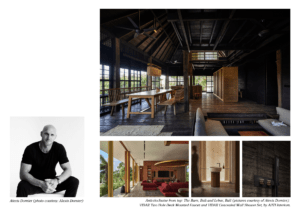
Other interesting examples include Alexis Dornier’s The Barn in Bali, which reuses salvaged wood and steel: its structure includes “ethically sourced reclaimed timber” for columns and floors, with “recycled materials forming the stairs, walls, doors, windows, and balconies”.
The above shows that architects across Southeast Asia are already proving that waste can be repurposed into architecture. Similarly, the next generation of young designers have also been coming up with innovative ideas to resolve environmental and social issues. For instance, student designers conceived the “Brick by Brick” coastal housing project that literally turns plastic litter into modular bricks, addressing the pressing issue of coastal plastic pollution by integrating it into functional and sustainable architectural components.
For Southeast Asia—a rapidly growing region facing waste and climate challenges—embracing such circular design is urgent. The call to action is clear: architects, policymakers and communities should incentivise reuse (through design competitions, building codes, and public awareness) so that our next generation of structures is defined by ingenuity rather than garbage.
Sources: Contemporary architecture reviews and project reports document how recycled materials—from cardboard tubes to bamboo to plastic bottles—are being used worldwide: alexisdornier.com, bluprint-onemega.com, architecturecompetitions.com, architecturaldigest.com, archdaily.com, bluprint-onemega.com, shigerubanarchitects.com, especially in Southeast Asia, to reduce environmental impact and spark innovation. These sources informed the examples and analysis above.
Main image credit: By Mark Fischer – Million Bottle Temple, CC BY-SA 2.0, https://commons.wikimedia.org/w/index.php?curid=45026666