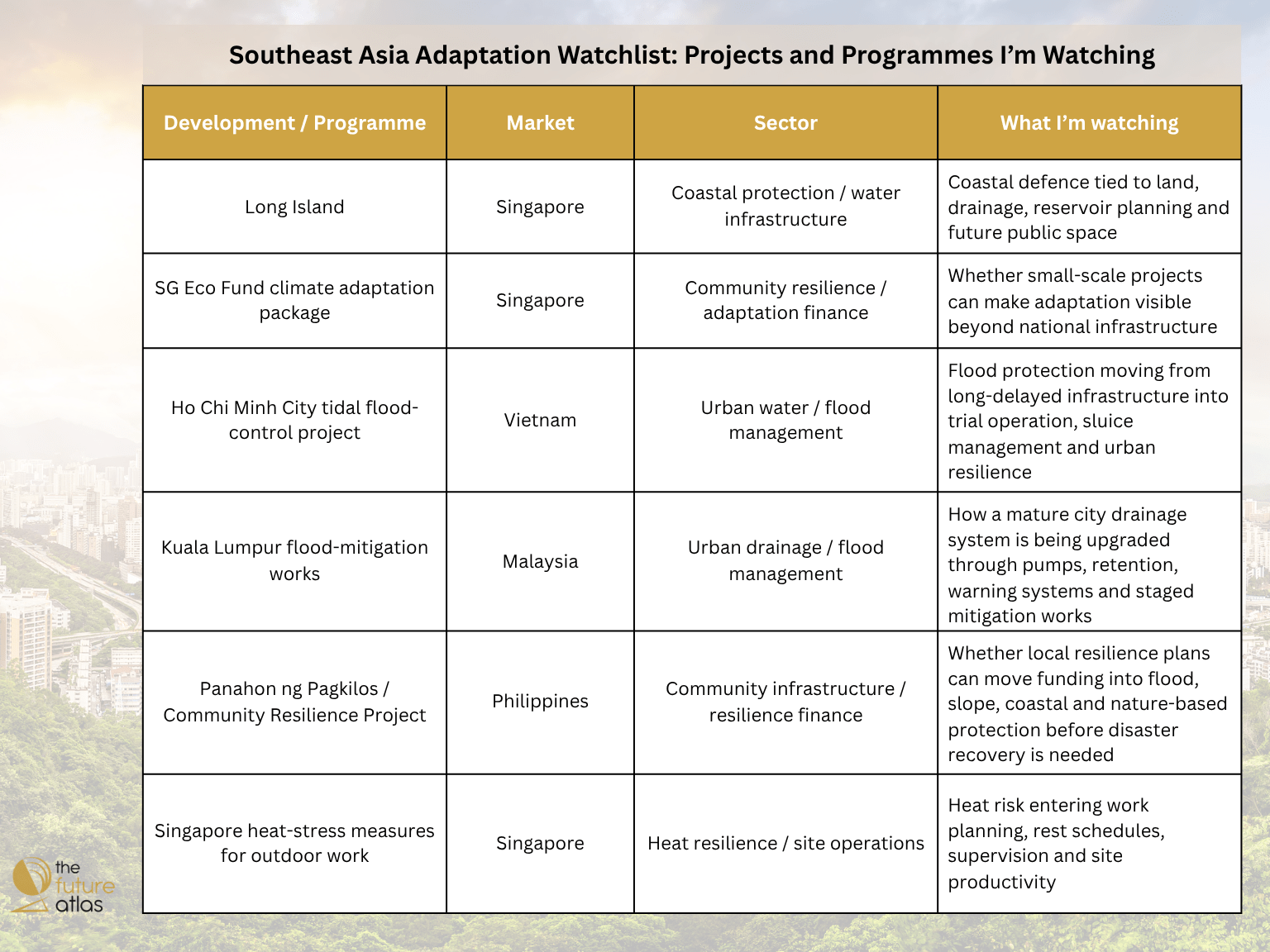
Long Island is the largest and most visible item in this list. PUB describes it as an integrated solution for the City-East Coast area, involving around 800 hectares of reclaimed land, two barrages and pumping stations for flood management. Technical studies are underway. Read only as coastal defence, the project is already significant. Read as land, drainage, future reservoir planning and public space, it becomes a longer urban question. (PUB, Singapore’s National Water Agency)
The SG Eco Fund climate adaptation package works at another scale. Under Singapore’s Year of Climate Adaptation, MSE is opening a climate adaptation package from 1 May 2026 to 30 April 2028, with support for community-led projects around heat resilience, flood protection, water conservation and local produce. The scale is smaller, but that is what makes it useful to watch: whether adaptation becomes legible in everyday community settings, not only in major infrastructure. (Ministry of Sustainability and the Environment)
Ho Chi Minh City is a reminder that adaptation can also mean stalled infrastructure becoming active again. C40 identifies the city’s tidal flood-control project as covering 570km² and protecting about 6.5 million residents along the right bank of the Saigon River and the central urban area. Vietnam News reported that the Bến Nghé sluice gate began trial operation on 2 February 2026 as the long-delayed VNĐ10 trillion project restarted. (C40 Cities)
Kuala Lumpur is less about one flagship structure. It is a city working through flood-readiness in pieces: pumps, monitoring, drainage, retention, warning systems and staged mitigation works. Local reporting in 2025 said DBKL had lined up 40 flood-mitigation projects for the capital, with some completed, some underway and others in longer-term planning. The row stays in this watchlist because mature cities rarely adapt through one clean intervention. (The Star)
In the Philippines, Panahon ng Pagkilos / the Community Resilience Project brings adaptation into local planning and finance. The World Bank says the project will strengthen community capacities for resilience planning and infrastructure investments. DSWD Field Office X reported in January 2026 that 15 municipalities in Northern Mindanao would implement the programme, with PHP279 million in indicative grants for 2026. (World Bank)
Singapore’s heat-stress measures are included for a different reason: they are already in force. MOM’s current guidance states that when WBGT reaches 32°C and above, employers must provide hourly rest breaks of at least 10 minutes for workers doing heavy physical work outdoors. This is adaptation as work planning. Rest, shade, supervision, sequencing, productivity. Very practical, very unglamorous, already here. (Ministry of Manpower Singapore)
Read together, these examples make adaptation feel less like a future chapter and more like a backlog of work already entering the system.
Water has to be held back, moved, stored or pumped.
Heat has to be managed during work.
Communities need funding before damage arrives.
Old assumptions need correction.
The work is uneven. Some of it is slow. Some of it is buried inside procurement, maintenance and operating procedures.
That is exactly why it is worth watching.
Sources
- PUB, “Coastal Protection Plan for City-East Coast / Long Island,” updated March 2026. (PUB, Singapore’s National Water Agency)
- Ministry of Sustainability and the Environment, “Year of Climate Adaptation / SG Eco Fund Climate Adaptation Package,” 2026. (Ministry of Sustainability and the Environment)
- C40 Cities, “Ho Chi Minh City: Strengthening the management of surface water resources and flood control capacity,” December 2025. (C40 Cities)
- Vietnam News, “HCM City restarts multi-trillion đồng tidal flood-control project,” February 2026. (vietnamnews.vn)
- The Star, “Ramping up KL’s flood readiness,” October 2025. (The Star)
- World Bank, “Philippines — Community Resilience Project: Pagkilos,” 2025. (World Bank)
- DSWD Field Office X, “‘Panahon ng Pagkilos’ targets vulnerable communities in Northern Mindanao,” January 2026. (DSWD Field Office X)
- Ministry of Manpower Singapore, heat-stress measures for outdoor work. (Ministry of Manpower Singapore)