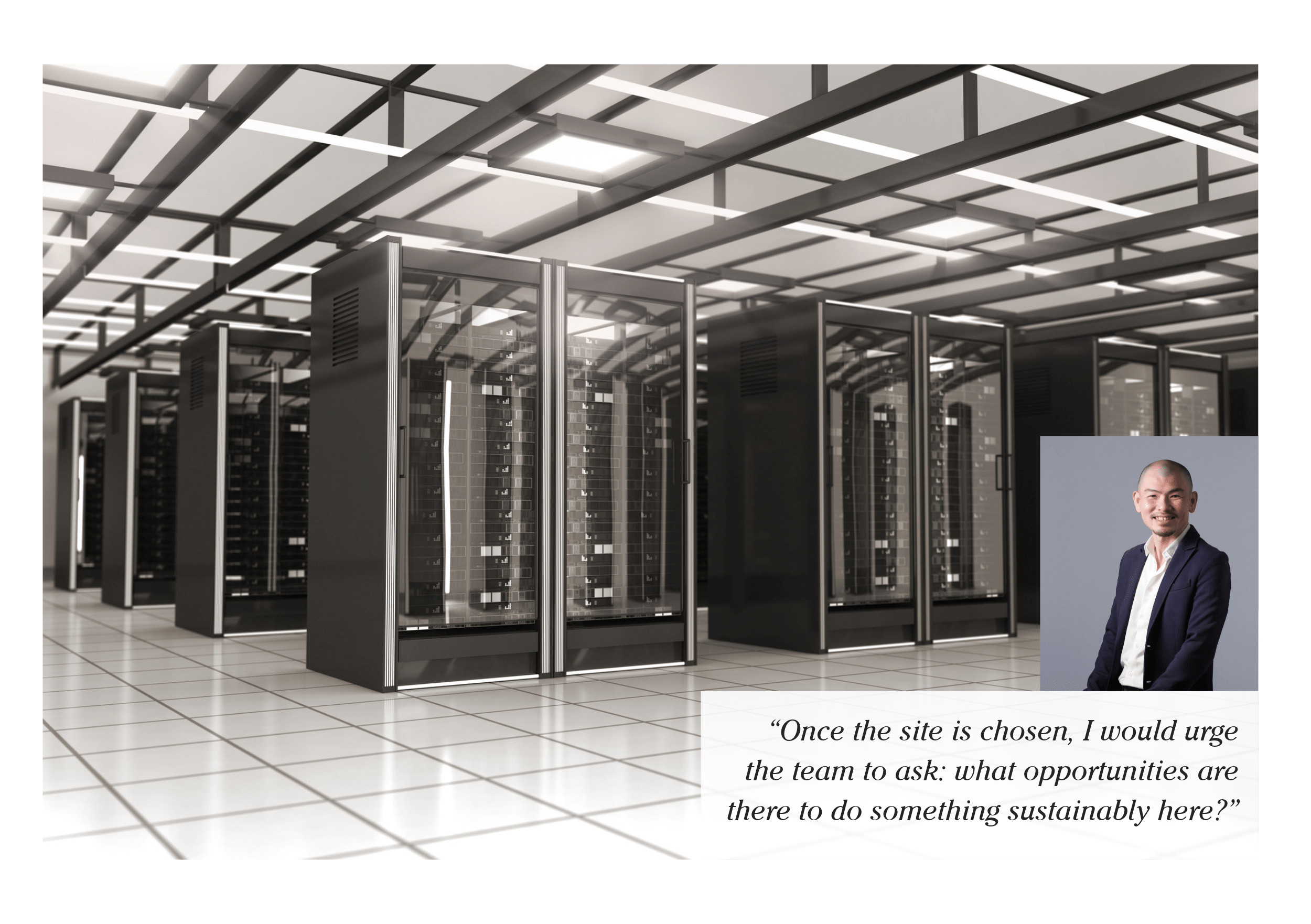
Hongsui’s answer to my final question is the right starting point for a project, and for this story. Our conversation focused on data centres, but the principle applies to any decent project: sustainability should enter the framework while there is still room to shape the site, systems and use of resources, and remain in mind as the work proceeds.
Which early design decision has the greatest bearing on a data centre’s energy and water performance over its operating life?
There are too many moving parts for me to name one technical decision. At the beginning, several sites may be investigated and test fits prepared before one is selected.
Data centres will remain for a long time. Over those years, a facility will continue to draw on resources, or it may find ways to give something back. It is better for it to be a contributor than a ‘depleter’. If the site offers a sustainability opportunity, recognising it early can improve the choices that follow.
Drawing on ID Architects’ digital transformation work, where can digital coordination make the greatest practical difference?
Without BIM, I honestly do not know how we would do our work now. Once you have experienced its effectiveness and efficiency, it is difficult to return to the old way of working.
A well-developed digital model becomes an important asset for a data centre. It records what has been built, provides a basis for future phases and reduces the effort required to reconstruct information later. If consultants, contractors and suppliers contribute accurate data within the same environment, the project gains a shared source of information rather than a collection of disconnected records.
This is an excerpt of Ar. Lin Hongsui’s interview published in Future Atlas 3Q 2026 digital edition. Read the full story there.
Ar. Lin Hongsui joined ID Architects as a Senior Architect in 2014 and became a director in 2017. He graduated from the University of Tasmania with Bachelor of Architecture (Honours) in 2003 and has over 23 years of diverse experience in a wide range of projects across Singapore, Australia, Japan, and other APAC regions. He is recognised for his design versatility and technical expertise in typologies such as industrial, institutional, and residential projects. He is also a key driver of digitalization and application of technology and innovation at ID Architects.